antique books and magnifying glass

About the Local History & Genealogy Collection

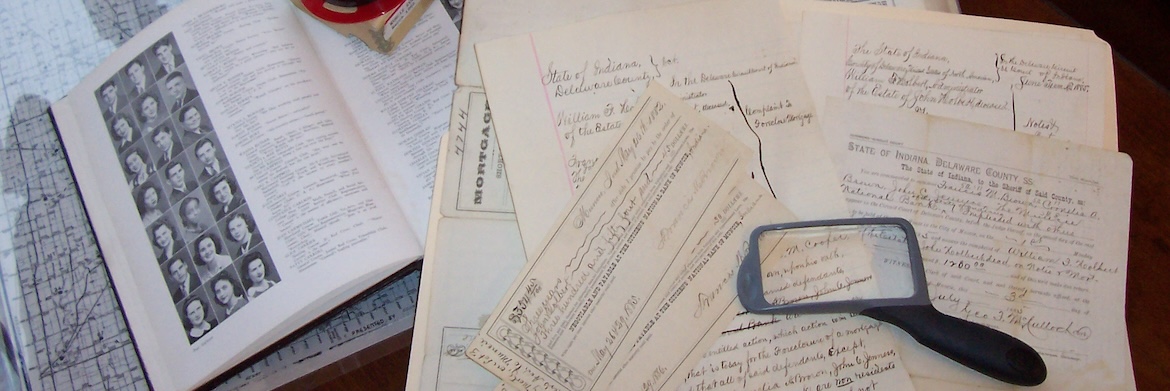
The Local History & Genealogy Collection is housed at the Carnegie Library branch and focuses on documenting the history of Muncie and Delaware County including its peoples, places, and events. Resources include but are not limited to: biographies, birth records, cemetery indexes, city directories, county and local histories, court records, death records, deeds, family files, funeral records, maps, marriage records, newspapers, probate records, school yearbooks, wills, and more. Special collections include: cookbooks, diaries, Indiana literature, manuscripts, photographs, scrapbooks, and other artifacts. The Local History & Genealogy Collection also archives the history of Muncie Public Library. 

Muncie/Delaware County Digital Resource Library

Muncie Public Library

Delaware County Court Documents, Wills, Deeds, Obituary Index, Funeral Home Records, and Beech Grove Cemetery Records. Muncie Public Library has been digitizing and hosting this database of Muncie and Delaware County records since the 1990s.

View Resource

Muncie Public Library Digital Archives

Muncie Public Library

Muncie Public Library's searchable digital archives of special collections of yearbooks, photographs, oral histories, and more. New content added regularly.

View Resource

Probate Index

Muncie Public Library

Alphabetized list of probate records available at Muncie Public Library.

View Resource

Ancestry Library

Ancestry Library

Genealogy database with billions of records from around the world including birth, marriage, death, census, immigration, military, and more. May only be used within the library.

View Resource (in library only)

MyHeritage

MyHeritage

Genealogy records from around the world including birth, marriage, death, military, census, and more.

View Resource

Indiana County Histories (Archives Unbound)

Archives Unbound

Indiana county histories and atlases from 1857-1922.

View Resource

ProQuest Historical Newspapers: Indiana Collection

ProQuest Historical Newspapers

Search or browse full-page digitized editions of historical Muncie newspapers dating back to 1900 and other Indiana newspapers. Click on “Publications” to view a list of available newspapers.

View Resource

Newspapers.com Collection: The Muncie Daily Herald: 1892 - 1906

Newspapers.com
Limited collection of newspaper issues available on the newspapers.com platform. Only available within a Muncie Public Library location. For access to all other Muncie newspapers on microfilm, please visit Carnegie Library.
View Resource (in library only) More Details

Newspapers.com Collection: Indiana State Library

Inspire lifelong learning library for Hoosiers

The Indiana State Library is digitizing its newspaper collection in partnership with Newspapers.com. Indiana residents can get free access to over one million pages by using the link on the INSPIRE homepage.

View Resource

Research Guides

These guides provide some guidance and links to resources to help you start your research.

Digital Exhibits

Explore digital exhibits created by Muncie Public Library.

Local History & Genealogy Collection Spotlight

Image for "Forging the "Bee Line" Railroad, 1848-1889"

Forging the "Bee Line" Railroad, 1848-1889

In the 1830s, as the Trans Appalachian economy began to stir and Europe's Industrial Revolution reached its peak, concerned Midwesterners saw opportunities and risks. Success of the Erie Canal as a link to East Coast economic markets whetted the appetites of visionaries and entrepreneurs, who saw huge opportunities. Amid this perfect storm of technology, enterprise, finance, location, and timing arose some of the earliest railroads in the Midwest.

By the late 1840s three such vision-driven railroad ventures had sprung to life. Two small railroads carrying goods to Midwestern markets - the Indianapolis & Bellefontaine in Indiana and the Bellefontaine & Indiana in Ohio - spawned early enthusiasm, but few citizens would look beyond the horizon. It was the admonition of Oliver H. Smith, founder of the Indiana line, who challenged the populace to look farther: "to decide whether the immense travel and business of the west should pass round or go through central Indiana."

Soon, the two local lines would crystallize in the minds of people as the "Bee Line." In Cleveland, meanwhile, a clique of committed businessmen, bankers, and politicians came together to finance the most prosperous of all early Midwestern railroads, extending from Cleveland to Columbus. Their aspirations expanded to control the larger Midwestern market from Cleveland to St. Louis. First by loans and then by bond purchases, they quickly took over the "Bee Line."

Hoosier partisans' independence, however, could not be easily brushed aside. Time and again they would frustrate the attempts of the Cleveland clique, exercising a degree of autonomy inconsistent with their dependent financial underpinnings. Ultimately, they acquiesced to the reality of their situation. After the Civil War, even the group from Cleveland fell victim to unscrupulous foreign and national financiers and manipulators who had taken their places on the boards of larger trunk lines expanding throughout the Midwest.

Exhaustively researched and meticulously documented, Forging the "Bee Line" Railroad, 1848-1889 is the first comprehensive scholarly work on this most important of early Midwestern railroads.